

Diesel near Shs7,000 a litre: what it means for your fleet, and what to do now
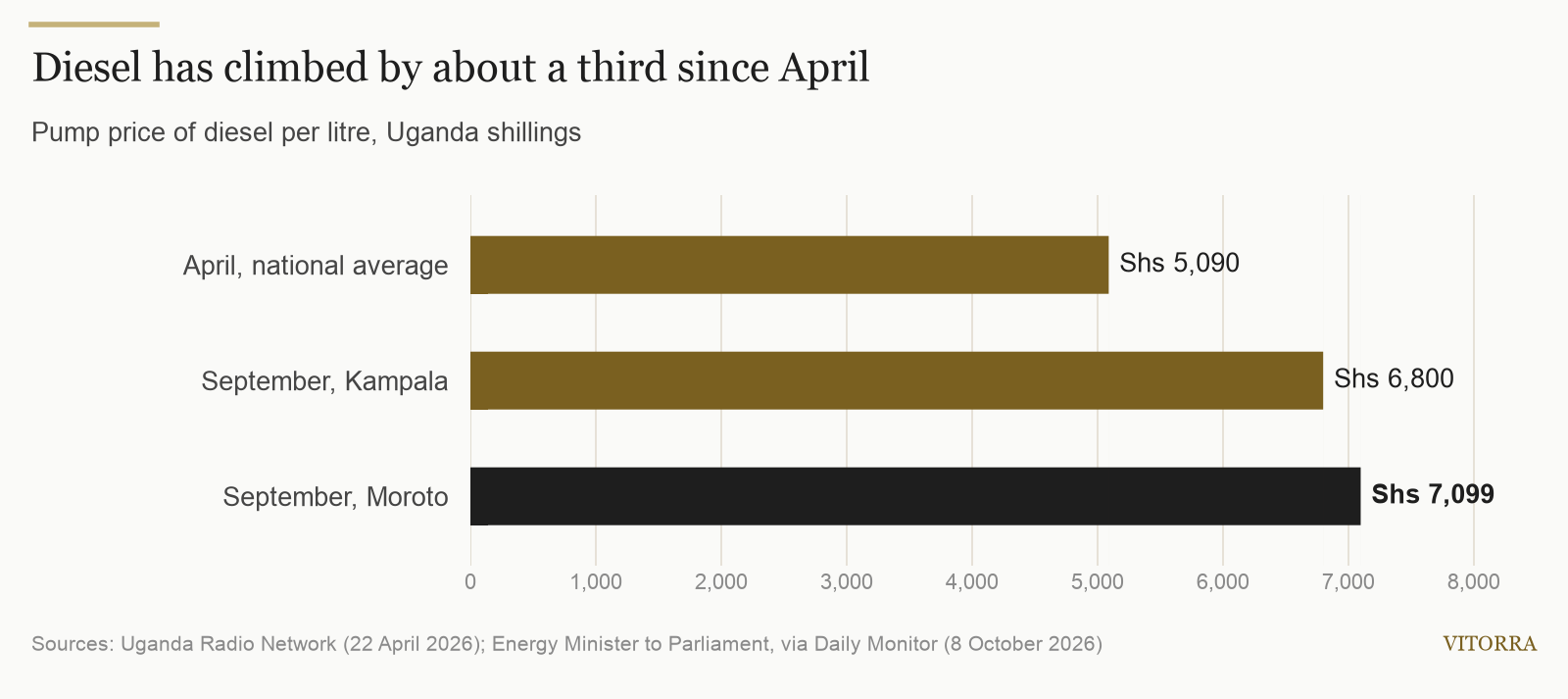
Diesel has climbed from about Shs5,100 a litre in April to Shs6,800 in Kampala and over Shs7,000 upcountry. Here is why, what it costs a working vehicle, and the steps that protect your margins.
If you run trucks, buses or delivery vans in Uganda, you have felt it at the pump. In April, Uganda Radio Network put the national average for diesel at about Shs5,090 a litre. By early September, the Energy Minister told Parliament that diesel was selling at Shs6,800 in Kampala and Shs7,099 in Moroto, with prices in Karamoja above Shs7,000.
That is one of the sharpest rises Ugandan fleet owners have faced in years. This article explains what is driving it, what it means in shillings for a working vehicle, and what you can do about it this month.
Why diesel is rising
Three things are pushing in the same direction at once.
The first is the world market. In early October the International Energy Agency urged governments to speed up releases from their emergency oil stocks, giving priority to diesel, after what its executive director Fatih Birol called "unprecedented tightness in diesel markets". Disruption around the Strait of Hormuz and reduced Russian supply after attacks on its refineries have squeezed diesel in particular. Uganda National Oil Company (UNOC) told MPs that the prices it pays for fuel products have risen from about $650 a tonne to more than $1,150, with some products reaching $1,200.
The second is the shilling. Uganda buys its fuel in dollars. According to the Energy Minister, Dr Monica Musenero, the shilling moved from about Shs3,790 to the dollar in early September to about Shs4,035 by 5 October, which on its own adds roughly Shs300 to every litre.
The third is tax. The Excise Duty (Amendment) Act, 2026 added Shs200 a litre to the excise duty on petrol and diesel from 1 July 2026.
Don't expect the government to set the price
Dr Musenero told Parliament that Uganda runs a liberalised fuel market, so the ministry does not set a uniform pump price; oil marketing companies set their own. The government says national stocks are sufficient to meet demand, and it is working on longer-term supply measures, including a fuel-sharing arrangement with Kenya and alternative routes through Tanzania.
Enough fuel in the tanks prevents shortages. It does not, on its own, bring prices down. Some MPs have called for temporary tax relief, but that debate was put off pending a wider government statement on the economy and the exchange rate. For planning purposes, it is safer to assume current prices will last for a while.
What it costs a working vehicle
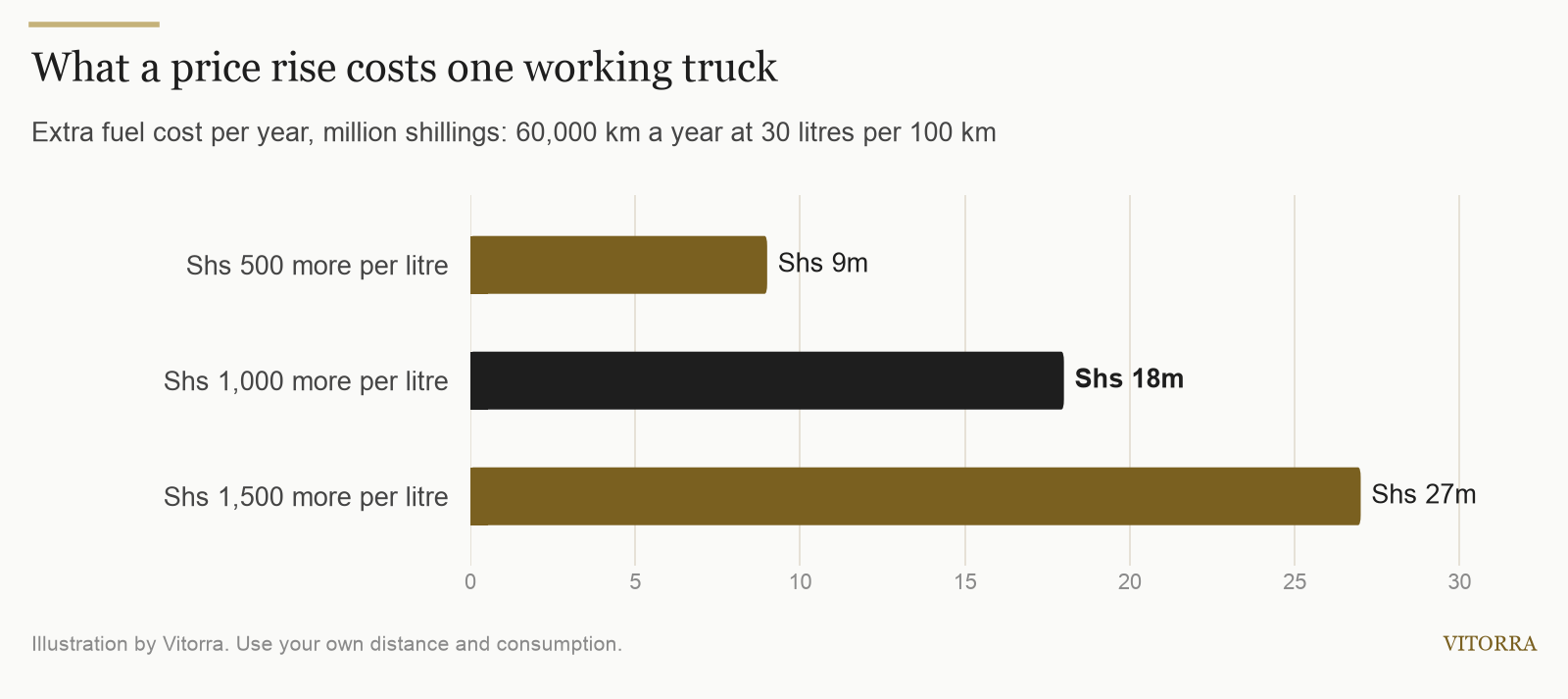
A simple illustration makes the numbers concrete. Take one diesel truck that covers 60,000 km a year and uses 30 litres per 100 km. It burns 18,000 litres a year.
- Every Shs500 rise per litre costs that truck Shs9 million a year.
- Every Shs1,000 rise costs it Shs18 million a year.
- Every Shs1,500 rise costs it Shs27 million a year.
- At Shs6,800 a litre, its annual fuel bill is about Shs122 million.
Use your own distances and consumption, and multiply by your fleet. For many transport, construction and distribution businesses, a rise of this size can be the difference between a profitable contract and a loss-making one.
What to do now
You cannot control the pump price, but you can control how much fuel you buy and how well your prices keep up with it.
- Re-price your contracts. If you quoted clients when diesel was near Shs5,000, those quotes may now lose money. For new and renewing contracts, consider a fuel clause that adjusts the price when the pump price moves beyond an agreed band.
- Update your budget. Rebuild this quarter's fuel budget at today's price, not the price you planned with in January.
- Measure each vehicle. Record litres and the odometer reading at every fill-up, and work out litres per 100 km for each vehicle. The vehicles using noticeably more than similar ones doing the same work are where savings start.
- Cut the waste you already pay for. Idling while loading or waiting, under-inflated tyres, clogged air filters on dusty roads, half-empty trips and fuel that goes missing between the pump and the tank all cost more at Shs7,000 a litre than they did at Shs5,000. Our practical guide to reducing fleet fuel costs covers each one.
- Judge any fuel-saving product on your own numbers. With prices this high, you will hear plenty of claims. Insist on a before-and-after measurement on your own vehicles and routes.
That last point is how we sell Fuel Eco Tech, a device fitted to the fuel line without modifying the engine. In an independent field test in Germany, a Volkswagen T5 van went from 11.52 to 9.92 litres per 100 km, a 13.9% reduction. One vehicle is not your fleet, so we offer a free fuel assessment that measures your own vehicles before and after fitting, and you decide on the result.
What to watch
- The shilling. Each move against the dollar feeds through to the pump within weeks.
- UNOC's price breakdown. MPs asked for a breakdown of the prices UNOC charges oil marketing companies, and the minister promised to provide it.
- Tax relief. Whether Parliament revisits the Shs200 excise increase when it debates the government's statement on the economy.
- World diesel supply. Whether emergency stock releases ease the international diesel market in the coming weeks.